5/5/15

Places on Earth: China


"China is a big country, inhabited by many Chinese."  

--Charles de Gaulle


 16 hours of airports and planes, our days and nights completely backwards, very little sleep on rock solid hotel beds--watch out China, here we come! It's a good thing our first stop was a foreign language middle school classroom, full of energy and smiles. Apparently Boomshakalaka was the word of the day. See it? The kids, in their track-suit uniforms, were excited to share a few English words with the American students, along with lots of nervous giggling. We gave them an Idaho map, a book about Sacagawea, and some Idaho potato pins and postcards. They gave us a healthy respect for the multilingual. Learning English is tough.


 ...Our next stop, Tiananmen Square, was much more sober. Not everything that has happened there was bad, but the bad things that have happened made it a hard stop on the trip for me. Our guide didn't talk about the protest, the tanks, the violence. He probably wasn't allowed to. There's no memorial to the hundreds, maybe even thousands who died. The line to see Chairman Mao Zedong's mausoleum had thousands of Chinese tourists, ready to wait hours to see him. I wondered what they feel, what they know, what this place means to them, And I tried to reflect on the future of Tiananmen Square, not just its past. Our guide expressed hope in their new leader, President Xi, that he'll be progressive in good ways. I hope so, too.


...From there were ventured into the Forbidden City. Don't worry, it's not forbidden any more. It housed 24 different emporers from two different dynasties. Built in 1406, it's hundreds of years older than our country. Most things in China are. With 980 buildings and over 8,000 rooms, it makes an impression. Because the Emporer was basically a deity, they had some strict rules. Not even the Emporer's sons were allowed to be there after they turned ten. It was a place full of politically manuvering concubines and eunichs, at times more than 9000 of them. We might picture the concubines as the most physically beautiful women in the country, but that wasn't always the case. They were daughters of important and wealthy leaders, or chosen for their brilliance. Our guide called it a sad place, because few ever saw their families again.


So, day one wasn't completely light-hearted, that's for sure. But it made me deeper, more appreciative, and that's what travel is for.

This lion was a favorite. If I could have hugged her without making a Western fool of myself, I would have. And yes, she's a she. That's a cub under her paw, which makes her a mama. A fierce, fierce mama.
These incense burners stood nearly as tall as me, and dotted the whole Forbidden City. They weren't burning incense, but it was easy to imagine a time when the courtyards were full of scented clouds.


 The crane represents longevity, something the Chinese are really good at. He lives outside the Hall of Supreme Harmony, the most important and biggest building in the Forbidden City, used for ceremonies.


 ...I had no idea we would be celebrities. This big guy from our group had never-ending patience. Tall, blue-eyed, and built a little like Buddha, people snapped pictures, stared, and even walked up and rubbed his belly for good luck. He very gracefully laughed. Though he got most of it, none of us escaped the curiosity--brown, white, tall, short--we were a walking exhibit. Maybe our variety is partly what made us so interesting. A group of Americans can be any shape, size or color, and we most definitely stuck out. Beijing and Xi'an (pronounced She-on) especially found us fascinating. Shanghai, not so much, but there are tons of foreigners there.

 ...The details on the covered walkways at the Summer Palace were incredible, and everything has meaning. The colors, the shapes, the dragons. Everything has thousands of years of significance. An Emporer had the walkway built in 1750, and it's covered in 14,000 paintings of historical events and folk lore. That's...just...a lot. Also, it was burned, along with most of the Summer Palace, during one of the Opium Wars and entirely rebuilt. So it's amazing twice.


Blossoms last such a short time, so being there to see the apricot, cherry and magnolia trees in their fanciest attire was good fortune.


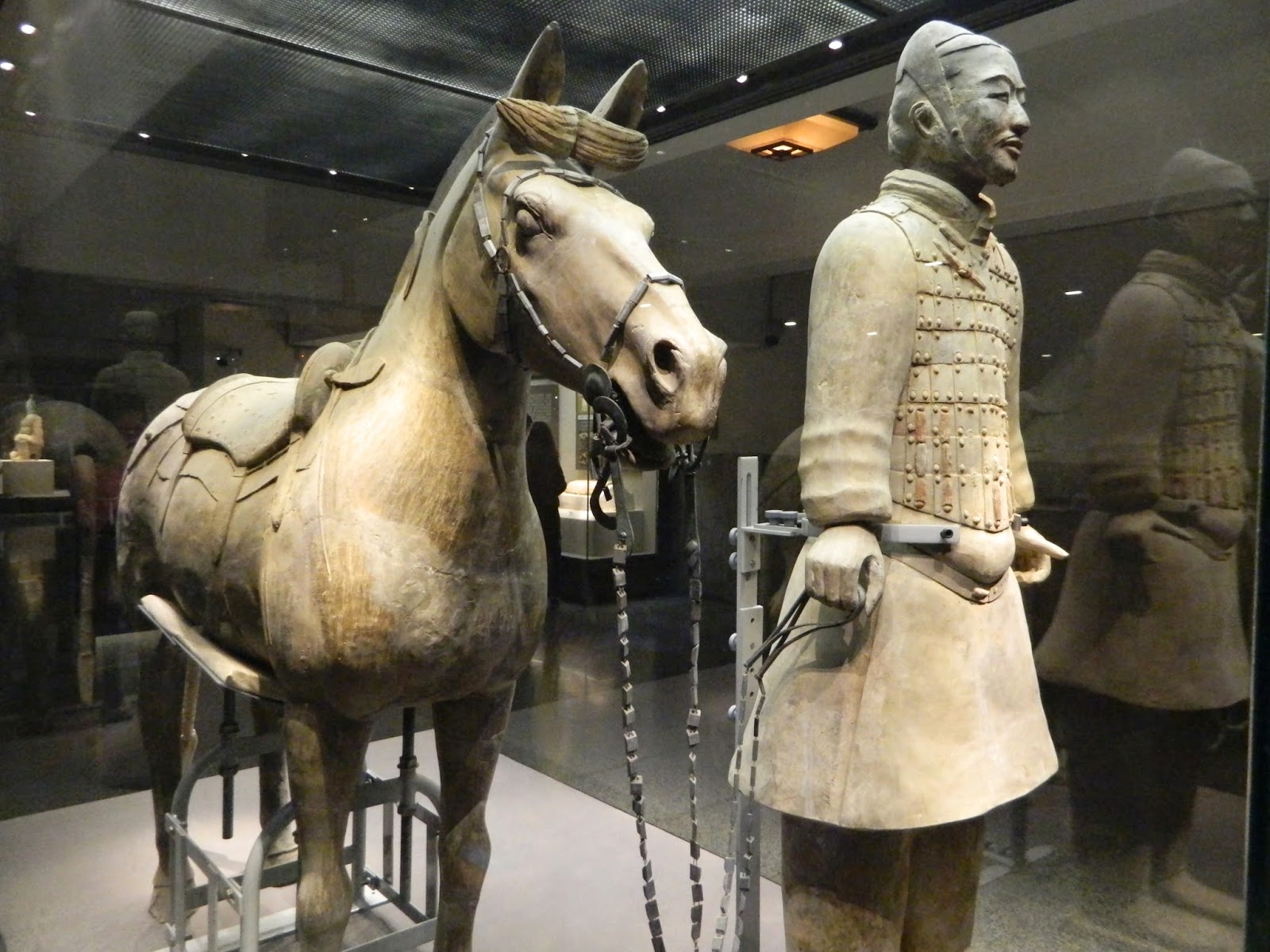

 ...I had no idea that only a fourth of the Terracotta Warriors have been uncovered. Estimates say there are at least 8,000. The first emporer of China, who united the warring states over 2000 years ago, had them made for his necropolis. His what? you may say. It means 'city of the dead', but does not mean zombies--they're undead. It was his tomb, which he wanted to be a microcosm of his empire. They were all built just to be buried.


According to an ancient historian, there were 100 mercury rivers, and the ceiling and floor were painted like the heavens and the earth. All of the Terracotta warriors were painted, too, and represented all the ranks of a real army. It took 700,000 workers 40 years to finish the tomb, just in time for Emporer Qin Shi Huang to die and be buried there. They haven't uncovered him yet, because they're waiting for better technolgy. The paint and other materials can begin to degrade in a matter of seconds.

What really stopped me in my tracks though, is that each face is unique. They say the artists who made them likely worked in pairs, using one another's faces as models. Knowing that these six-foot tall warriors look like someone who lived 2000 years ago...I don't have words.
The detail and the sheer numbers blow my mind, and there are many, many more to come.


The smog hurt my eyes, my lungs, and my heart. It's a tough battle when there are 1.4 billion people living in your country. (That's 20% of the world!) But they're trying. There were trees planted in every free space, they have regulations about driving, and they've made policies about their industries that will hopefully be carried out. It's the worst smog in the world. On a particularly bad day, most people were wearing face masks. I took a deep breath of clean air when I got home, and wished I could send one to my Chinese friends.


Oh, the Great Wall, one of the Seven Wonders of the World. Some parts of the Wall date back to the 7th century BC. At it's greatest, the Great Wall was 5,500 miles long. Humans did that. With their muscles and brains. And you can see it from space. I couldn't just walk, so we tried to run, but it's incredibly steep in parts. It was a thorough workout, making it to the highest watchtower, and I felt for the runners who had to carry messages. Just imagine signal fires being lit from tower to tower, sending military messages across the entire country. Like the Beacons of Gondor! Aw-haw-some! 

 English translations are part of the fun of China travel. It's good advice, to commit no nuisance.
 My favorite day in China was at the Temple of Heaven. They've made the park around the temple into a workout facility for retirees. This man was having a good stretch after doing two finger pull ups and turning flips on the monkey bars. He's 84 years old.
 In the background is the Temple of Heaven, built without nails or glue. In red is our Tai Chi instructor, Mrs. Wong, who really wanted us to know the take-down moves behind the slow, peaceful Tai Chi positions. I scored bonus points when I used them on Josh. She smacked my butt and gave me a thumbs up.


...China is this crazy mix of ancient and modern. This is the second tallest building in the world...

...in the same city as this ancient garden, created by a wealthy man as a peaceful place for his retired father. You can look out over the ancient buildings and blossoming trees and see rows of skyscrapers, and that's so China.

 ...this dragon almost got an entire family killed. The Emporer found out they had made this dragon fence, and he had a monopoly on dragon decorations. They escaped death by pointing out to the the investigators who came that there are only three claws, not the traditional five, and thus this was not a dragon and they should not be executed for displaying a symbol of power, and that no, it was not a metaphor of their desire to take over the government. Phew! That was a close one! What a difference a few toes can make. They really toed the line after that. Ha. Isn't he incredible though? Also, for the geek-hearted, Chinese dragons differ from Western dragons in a few cool ways: No wings--they fly by the magical powers given them by the giant pearls they hold in their mouths, which stop them from breathing fire. At least that's what our guide told us. I have a feeling there are dragon enthusiasts out there who would disagree.


This was my second trip to China, my second time standing on the opposite side of the earth, and both times I've come away having met some of my favorite people, amazed at how long the culture has existed, and reminded that people are people, even 6000 miles away from home. I hope good things for you China, and your billion and half people. And thanks for the bok choy and rice. It was delicious.


6/10/14

Places on Earth

Until I went to Costa Rica...

I didn't know that.....


I love rice and beans for EVERY meal! Also, I like not cooking for EVERY meal!

They have 20 different kinds of bananas, and some of them taste like potatoes.

Goat cows. Cows really, but they're smaller and have long floppy ears like goats. Goat cows.

Macheti is pronounced like it's written, not with a "sh" sound.

You can pick one up at the local hardware.


Passion fruit looks NA...STY. Like frog eggs. Delicious though.


This.
It's a passion fruit cupcake from the Wild Ginger Bakery in Tortuguero.  
See how it made me very, very happy? 
Also, don't leave your mascara on the counter at home.


Two kinds of ginger grow wild in Costa Rica. Lots of edible things do. Favorites: coconut, mango, plantains, rambutans, heart of palm (tastes like bacon!), guava (a legume) to name a very few. The slightly wicked looking pink and red fruits with green spikes are the rambutans. Inside it's like a big, extra sweet grape. They have a slightly different version in China, but that's for another post.


They say if you get Costa Rican dirt under your nails, a mango tree will grow. 


Maybe not, but if you build a fence, it will grow. 
Chop a branch off a tree, stick it in the ground, it just can't help it. 
Everything in Costa Rica grows.


Howler monkeys don't actually make a howling sound. I would say it's more gutteral, predatory, angry and terrifying. I was under the impression that whatever made that kind of sound would certainly want to devour me. But that was before I discovered it was just this amazing mama right outside our cabin. FYI: They wake up at about 4:30 and want to have a conversation about what happened last night. "Hey Phil, you still alive?" "Yeah, dude, but a jaguar got Stan." FYI: The rainforest is a little bit scary. 


The blue bags are covering banana bunches. The bunches are at least three feet long, and 25 of them go on a pulley system called a banana train. One young Costa Rican guy pulls the train from the field to the plantation. Only 10% of Costa Rican men are strong enough to do this. They don't just pull. They run. All day. 


 The spines of the pineapple plant are the seed. I just never knew that. 

Costa Rica leaves almost zero carbon footprint. 
They use geothermal energy and have huge recycling education programs. 

This is a recycling bin. It doesn't make me want to recycle. 


This is better. 


The geothermal energy comes from this (active) volcano, Arenal.
Arenal is cheeky. Red snakes of lava used to slither down the mountain, glowing at night, so investors built hotels with room views. Arenal promptly switched her flows to the other side of the mountain. Investors purchased buses to drive tourist to the other side nightly. Arenal promptly ceased all lava flows. She still vents gas. If she stops doing that, Costa Rica may have a problem. 


Costa Ricans, like three-toed sloths, know how to take it easy. They call it "Tico Time", and if you stay there long enough, it starts to grow on you like the moss on this sleepy sloth's back. Fruit, warm sunshine, the sound of the ocean and 100 different animals, and a hammock. It has a Neverland effect and I almost forgot to come home. 


Teens can be more appreciative of new experiences than adults.
Probably why I write for them. 


I did not bring home any viruses, parasites, insect bites or jellyfish stings. (Only a few of us did, and they were all minor). I did however, catch a case of Pura Vida.... Costa Rican for chillax. 


There's only one sun, but every night it creates innumerable paintings all over the world. 
One artist, a million canvases, and I got to witness this one.  

3/7/14

Derick William Dalton


JP - Welcome to my blog, Mr. Dalton! Say hello, everyone. This is my oldest brother, who’s a father-physician assistant-triathlete-writer by day, exhausted by night. He’s been grabbing great reviews for his science fiction novel Houses of Common. 

DWD - Thanks. I have to admit some disappointment. When the alert pops up in my email that you wrote another blog post, the excitement of ignoring my responsibilities to read it will be dampened because I'll already know the ending. Your blog is fantastic.

JP – Why, thank you. Your book is fantastic. With blog tours happening all month this has to be a pretty exciting time for you. How does it feel to hold your book in your hands?

DWD - Reviews from people I don't even know! Yes, I'm very excited. I was a guest poster (not Guess poster—that was Claudia Schiffer) for The Bearded Scribe (here). I had an interview with Cynthia Rodriguez who's an active duty soldier in Afghanistan (here). She also posted an excerpt of Houses of Common. 

But holding my book? This may sound weird, but really, this is the experience. On day one of physician assistant school, we had a presentation on addiction recovery. The presenter was a counselor who facilitated rehab, and told his own story of addiction. "The first time I ever had a beer was the first time in my life I felt normal." When I pulled that first copy of Houses of Common out of the box, there was a brief rush of excitement of course, but mostly, I felt normal. More normal. As though I understood the concept of normal more accurately than before. Having the final manuscript safely backed up in three places was exciting, like when I was dating a certain redhead. Holding the book with the cover art and my name on it? That was being married to the redhead, realizing how much more real the relationship was. Not tentative, not inhibited. Normal.

Seeing the movie version of the novel? That would be later. The kids and the messy house and the crazy schedule and the lack of sleep and the "remember when it was just us?" Or so I imagine.

JP – Oh, man, your book would make such a great movie! And I’m sure watching your own characters on the big screen would be something like parenthood—only without the smells. If your book did become a movie, one of my favorite scenes would be the chase through the entire solar system. I won’t divulge too much, but I love that in the future you created there is a Planetary Parks and Preserves department, and they don't mess around with vandalism. What about you? Favorite scene.

DWD—Speaking of vandalism, chapter two involves some that was satisfying to write. The main character, Ranyk, has enough with commercials. Being in orbit with the satellites, he decides to do something about it. Other favorite scenes? One character is a kindergarten teacher, and watches her husband help with class science lessons. She sees the depth of his kindness despite his harsh upbringing. Ranyk's sister is the head of security for a US Embassy. She simultaneously beats up an employee who attacks her and calls the office staff to inform them he's fired. Without a break, she blasts into orbit to take out an assassin. Ever wonder what would happen if Star Trek superfans actually had starships? You'll meet one. Perhaps my favorite scene is when Ranyk earns himself a contempt of court charge.

JP—All great scenes. I’m especially fond of the Trekie. Very memorable, for sure, and that’s one of the things I love about your book. Not only is there cool action, your characters are deep and complex. You know, like me.


One of the things that intrigues me most about Houses of Common is the Office of Terraformation. You’ve obviously done a ton of research. For those of us not well versed on terraformation, give us a quick crash course. 

      Office of Terraformation T-shirts! Sweet, right?

DWD - Heehee! You sure you want me to get all geeky? Too late! Terraformation is converting a planet's environment so humans can live there. With Mars for example, the hypothesized plan includes spreading photosynthetic bacteria on the surface to increase oxygen and greenhouse gasses in the atmosphere, and to darken the surface so more sunlight is converted to heat. The next step is getting plants to grow, and there are some successes with this already in lab-simulated Martian environments. A tough part with Mars is its lack of magnetic field. Solar radiation would blast the new atmosphere into space. I know that's going to keep you up at night now. All those poor molecules, drifting away toward the asteroid belt…

It's a centuries-long process, but I figure in that the future scientists will be able to tinker with genes such that it's decades instead. And why not tinker with genes of the humans so they can tolerate a harsher environment?

JP—I find my mind blown. I do have a serious problem with your book, though. One of your characters has devoted his life to flying around the galaxy terraforming. He’s just walked into a lab where they train people in the skills necessary to make a planet livable:

“To humans, Ranyk was sure the place held a rich, garden aroma, the lights dusting it with a supernatural glow. To him it dispensed a heavy, palpable fog, reverberating with life and defiance. Here chaos and entropy were toppled from thrones of tyranny, shackled with the genes of living cells. In this abandoned warehouse was Ranyk’s purpose in microcosm; the filling of a void with life, whether it be an empty pot, a roof top, a continent, or an entire planet.”

So hold on there, Shakespeare. I thought this was sci-fi. What’s with all this stirring prose? Are you trying to sneak culture into my action/adventure? I’ll tell Mom.

DWD - Tell Mom what? That I wrote... Oh. You mean tell her about that other thing. It's been 25 years. I think you're bluffing, and if not, I don't think she'll care anymore.

No, I'm not sneaking culture into sci-fi, I'm showing 20th century literary fiction authors how to write a book that doesn't suck.

JP—First of all, which other thing? The projectile egg, the kitchen slip-n-slide, or the cat bowling? Because I think she already knows about all of those. We weren’t as sneaky as we thought. As for sneakiness, I still think you’re trying to pull a fast one on us, but I like it. I think all authors should try to find a balance between literary quality and entertainment. Otherwise, we’ll all be, like, dumb. Or bored. Literally.

DWD – I didn’t know Mom knew. Well there goes my leverage.

JP—The cat bowling got me thinking about being kids, and I just remembered our one and only childhood fight. You’re so, so much older than me, that we never really got into it. But, there was this one time that you were playing catch with me in the yard. You kept throwing it too hard and scaring me so I chucked the ball at you, missed by a mile, threw my mitt down and yelled, “You’re throwing it too hard, you butt head!” *exit stage left, huffily*. Remember?

DWD - Yeah, now that you mention it. It was the "butt head" that reminded me. That was the go-to insult at our house.

JP—Quite so. With occasional variation. My point is, it’s kind of like writing. First drafts are usually a bit…not ready. It takes guts to write garbage, throw it out, try again, get it less garbagy and then give it to people to criticize. Readers throw critiques at you and it hurts. But then you realize, Hey, I listened and now that part isn’t garbage anymore. Behind every good book, there is someone who threw some really hard edits at the writer. You helped me immensely with my novel, and I was absolutely indispensable to you. See how I brought that back around to me? It’s because I’m the youngest.

Really though, thanks for being willing to throw hard stuff at my face. Wait—I just had another memory. I’m pitching you a softball, you’re swinging the bat, CRACK—it’s slow-motion now—the ball bounces once right in front of me. POW! Right in the kisser! I COMPLETELY FORGOT YOU BROKE MY FACE WITH A SOFTBALL! I TAKE IT ALL BACK, YOU BUTTHEAD!

DWD - Umm, sorry? You got a good life lesson out of it. That's what I was thinking when I did those things. "Someday, she'll see the benefit of blah blah blah."

JP—You’re right. It was a long time ago and I forgive you. Good thing you can run faster than me. And longer. Isn’t running when you get most of your ideas? And how do you deal with being miles from your computer when inspiration hits? How’s the Iron Man training coming? And one more—are you nuts?

DWD - Running's the thing. See, I'm severely limited in what mind altering substances I can use. Limited professionally and by my internal moral compass. But, running is my trigger for endorphins. That's short for endogenous morphine. Yep, you read that correctly. Morphine! I'm a better cook of better goods than Mr. Breaking Bad, and the only equipment I need is good shoes. Of course, I can't sell mine... Cycling works too, but not swimming. Probably because my brain is concentrating on not drowning.

JP—You go scary fast on your bike. My body wouldn’t make endorphins if I went that fast. It would make wee wee.  

DWD—All the way home? Ideas also come because I run on trails instead of the street. One of them is through national forest and 300-year old trees. Is my life real? My job? Human civilization? Yeah, but I look at the size and age of those trees. The sounds of leaves and grass and wind and the chemistry of photosynthesis. I smell the soil and needles and think of the complexity of bacteria and fungi in the ground. Millions of species and billions of years. That's reality. It rocks my world and makes "real" life boring.

JP--You sound like your character Ranyk. I think you would have been a terraformer had you been born a tad later, or maybe you already are, you just use words instead of genes. 

But, you're out in the middle of the fungus and photosynthesis when an idea comes. What, do you whisper it to the trees and they pass the message along to the big pine in your back yard? 

DWD—That's me, the plant plot whisperer. I've texted myself before. Tried association tricks with my fingers or mnemonic devices. My trail running pack has paper and pencil. It all works as long as I write it down when I get home. I can remember until then, but "real" life doesn't like new ideas and pushes them into oblivion. I did an off-road triathlon several years ago. I wasn't competitive at all, but when I crossed the finish line I ignored the hot girl handing out water and ignored the cramps in my calves and thighs and ran for a paper and pen. Those notes became three fat chapters and two plot twists. So now that the book is published, I draw on the principle of degrees of separation and tell people I'm a professional triathlete.

JP—I've seen you go dashing for paper, and I've done it myself, though not as quickly. My ideas used to come in the shower, so I started jotting notes on the shower wall with dry erase markers. Turns out they have to be dry in order to erase. I've got four kids now and I don't get to shower, so my muse has become the laundry. Okay, I don't want to talk about that anymore because I might cry a little bit. I love my kids but I do not love their dirty clothes. Let's talk about other things that take all day, like the Ironman.

DWD—Getting ready for the Ironman is going well. There's a growing trend in training schedules to back off on the long workouts and focus on intensity. The hypothesis is that pushing the anaerobic threshold up in short killer workouts rather than long death marches, then backing off and staying under that threshold for the race, is a more efficient use of training time. I was an almost mediocre contestant for seven years, just having fun. But I threw weight lifting and body weight training into the routine, and last year I turned in an above-average finish in an Olympic distance race. That's when I knew an Ironman was a possibility without ignoring my family for five months. They didn't even know I was training or planning to compete until three months in.

Nuts? Maybe. I prefer to be called a socially acceptable morphine addict whose habits have beneficial side-effects. 

JP—One of those beneficial side-effects is writing wicked good books, so keep running! And please finish the next soon! Thanks for including me in your tour, bro.
Houses of Common is available on Kindle here, and paperback here with a code for $4 off (APSQBFT8). But if you want a FREE SIGNED COPY, be the first to leave a comment or question. Maybe he’ll even kiss the title page with lipstick. Heeeehee. That would be hilarious!
Help DWD keep his dream progressing by leaving a review, or marking existing reviews as helpful on Amazon, and liking his page/sharing this interview on Facebook. He also has a page on Goodreads.
DWD’s blog is here if you want to stay up to date on the novels and short stories available. You MUST read Sterile Field. An excerpt is included with Houses of Common, but I promise you, it won’t be enough.
Any final words, DWD?
DWD—Mom! Jessie's the one that threw the egg in the kitchen! 

JP—Lies! I was the one who bonked you on the head with the meat tenderizer causing you to throw the hard boiled egg into the living room. Wait! No—it was Tyler! Absolutely that was Tyler. And I will delete any comment he posts that says otherwise. Because this is MY blog. And I’m the baby.


3/4/14

Calling All Terraformers! (if you're not geeky, Google it--it's rad!)

Coming soon! An interview with author Derrick William Dalton! His sci-fi novel Houses of Common got this review from Diann Thornley Read, author of The Sergey Chronicles, a military science fiction trilogy:


"If I didn't know better I never would have guessed that "Houses of Common" was Dalton's first novel. He is, hands down, the best new writer I've read in years - and better than some long-time pros I've read lately, too! The plot races like rapids through a canyon, with all the twists and turns "rapids" implies; the well-researched science fact melds seamlessly with science speculation; the array of human and non-human characters are developed to a psychological depth and breadth that you feel you've known them all your life (my favorite is Ranyk, the smart-mouth alien terraformer); and Dalton's storyteller "voice" is clear and confident. I can't wait for the sequel!"


As part of his book launch, I get to interview him on Friday, March 7th. First person to comment on the post will win a FREE, SIGNED COPY of Houses of Common. Oh, and by the way, Derrick William Dalton happens to be my big bro and writing partner, so I know all sorts of juicy stuff you won't find anywhere else. To watch him helplessly attempt to defend himself against the cunning wit of his little sister, tune in FRIDAY-FRIDAY-FRIDAY!

1/3/14

Kitchens


Places from childhood sometimes seem smaller when we go back, but the kitchen of my childhood was always small. Mom and Dad built their house on Ski Hill Road in 1980, intending to sell it as a second home for skiers. The kitchen was . . . well, let’s just say I’ve had closets bigger, and my folks would have done things differently if they’d known we’d live in that house for nearly 30 years.
Don’t get me wrong. I’ve had ten kitchens since then, and it’s still my favorite. Or at least top three. That first kitchen had a gravitational pull, and even though we had far bigger rooms to gather in, somehow we ended up in the kitchen, gangly teenage legs dangling off the orange formica counters and Mom and Dad stacked double-decker in the corner with their arms around each other. You couldn’t open the fridge and the oven at the same time. You couldn’t open any two things at the same time. When the orange formica finally went I was sad, because I was the only kid in the high school who’s kitchen matched the school colors.

In that kitchen I learned to always check the sprayer on the sink for rubber bands before turning on the water, an entire day's worth of dishes can be cleaned up in the thirty seconds it takes mom and dad to walk from the driveway to the front door, and metal pots do NOT go in the microwave.

The window above the sink looked out over the back yard and the storage shed. Magpies used to chase the cat off while she tried to eat, so Dad would slide the window open, nose his shotgun out and see how many he could . . . scare off. Can't tell you how many summer mornings I woke up to a shotgun bang and fell out of bed, heart pounding. Dad would open my bedroom door and say, "Seven!" (If he didn't want me to tell on him, he should have saved the target practice until a decent hour.) Dad didn't just fire guns in the kitchen. He made the best breakfasts ever. Once the magpies were taken care of, that is. First things first.

Mom fed a gaggle of relatives every Christmas Eve out of that tiny kitchen. She fed them so well, they came back year after year. Her Clam chowder is the best in at least the galaxy. One cousin ate so much he raced to the bathroom to throw up, then went straight back to the kitchen for another bowl. No joke. I can’t point fingers, though. I have no memory of it, (how unfair life can be), but family lore says that while sitting on the orange formica counter on such a full-bellied Christmas Eve, I barfed right into my grandma Udy’s boots below me. My brother swears every drop went in the boots, but Dad took a picture of Udy wiping the floor with a smile on her face. Mom swears Udy would not have smiled when she was a kid.

Udy’s kitchen is the second in my memory. I went there almost every day after kindergarten, and Poppy made me ramen noodles because I was Princess Poobah of Ramen. It smelled like cigarettes and coffee, and toast and dishwashing soap. Goblets I swear were made of every color of candy but were NOT to be touched lived in tempting little nooks next to the pantry. Grandma’s are supposed to have yellow counters and dark cupboards, because both of mine did. Udy and Poppy’s kitchen had a magical drawer that always had a bag of Oreos. But like all treasure, it was protected with a curse. No matter how slowly or quickly I pulled, not matter the trajectory, velocity, angle, degree, prayer, or cover noise, Udy always heard the squeak. She'd laugh, hoarse and wheezy, then tell me I could have it if I brought her one, too.

Grandma Betty’s kitchen smelled like Betty Bread and laundry, and Grandpa’s greasy work jacket in the front closet. Strawberry milk only ever tasted good to me at her house. I’d sip from a brown plastic Tupperware cup while she kneaded a huge lump of dough that looked a lot the the soft backs of her arms. I loved Grandma’s plump arms. I hope when I’m a grandma I can accept that grandma arms are supposed to be soft and huggy, and kind of jiggly, like bread dough. We only visited Grandma and Grandpa’s kitchen a few times a year, so she had to feed us enough to last several months. Every holiday the whole family lay strewn around the wooden console TV in the living room, groaning in gastrointestinal distress after an immense meal. Not five minutes would go by before Grandma would ask, “Are you hungry? Can I get you some jam and bread?” We’d all moan and say, “Yes, please.”

I wish the last time I was in both of those grandma kitchens could have been like it used to be. But kitchens change. After Udy died, Poppy started to need help. My mom or my aunt were there every day, and during the summer on my way to my groundskeeper job at my dad’s elementary school, I would stop to make Poppy breakfast. Hashbrowns and eggs over-easy. Only I sucked at eggs over easy and Poppy always laughed when he heard me say “Crap!” from the kitchen. Every morning the yolk broke, and every morning Poppy said, “Thank you, m’dear”, which meant, “I love you, kid.” The last time I was in that kitchen, my aunts and mom gave me Udy’s untouchable candy red goblets. The funeral was done, Poppy was with Udy again, and their home turned into just a house, with just a kitchen. They sold it to someone who turned it back into a home, though. Maybe they have an inexplicable desire to keep Oreos in the bottom drawer.

On my last visit to Grandma Betty’s kitchen, Grandpa gave us strawberry jam he’d made by himself that year. Then he pulled a loaf of Betty Bread out of the freezer and we all missed her so much it hurt. Watching grandpas cry is hard. Grandpa couldn’t live there without Grandma, so I didn’t get to say goodbye to that kitchen. I didn’t get to say goodbye to Grandma either, at least not the way I would have liked to. My kids wonder why I cry while I knead the rolls at Thanksgiving. I tell them all about my grandmas and how much I love them, but they won’t really understand until it’s their own hands doing what grandma’s hands used to do.

My first kitchen of adulthood, (legal adulthood, anyway), was in a college apartment and my mom rolled her eyes because it was twice the size of her kitchen. It may have been bigger, but the food quality did not increase proportionately. I did not gain the freshman fifteen. In order to do that, one has to make food worth eating. My mom had taught me not to buy junk food, so I nearly starved. Luckily, the next year I lived in a new apartment with a handpicked group of friends and, thank heaven, they knew how to cook! Every Sunday we ate together, so once a week I had something besides bean burritos and apples. When we assigned dishes, I always said, “Uh . . . I have a cake mix”, until it became my catch phrase. Truly, I was just terrified to cook for people. StilI am. I learned a lot of things in my first kitchen, but how to cook wasn't one of them. Luckily my roomies tried to get me up to speed, and I started paying closer attention when I went home to visit.

My next kitchen, I don’t really want to talk about. But it was a kitchen, by definition, so I will. The first place Josh and I lived after we got married was a basement.  It was only for the summer so we could work for higher wages in our home town and save up for school in the fall. No matter that it had flooded and all the sheetrock lay in a gloppy pile in the center of the floor. Heroic efforts went into cleaning it up so we’d have a place to crash for a few months. There was a fridge and counters and a stove and cupboards, all second-hand, and all installed by Josh and his family with lots of love and good intentions. But the little, gappy hundred year old house was plopped right on the mountain side, yards away from National Forest property, which belongs to creatures. Josh promised that he would empty all the mouse traps before he left for work at 4 am every morning, but not all the critters were always in traps. After we moved out, the work continued and that little kitchen was just what a lot of different people needed. But it’s still not in my top three.

Our next kitchen had a mini stove that wouldn’t fit the cookie sheets, no room for a table or a microwave, and no creatures, so I loved it. That’s the kitchen where we gained back the weight we lost during the first months of our marriage, but it wasn’t because I was any better of a cook. We lived a few blocks from Papa Murphy’s, and we had coupons. In that kitchen, I started to worry about my lack of cooking ability. I had my mom’s recipes, but they hated me. I am so grateful for that, because Josh decided if he wanted good food, he had to make it himself. It was awesome. It still is awesome.

After we transferred to a new university, moved into a condo and had our first baby, my kitchen and I were still at odds. I had homework to do, and cooking dinner while holding a baby is an art form I'm still studying. I conquered a few recipes, but there was still something missing. We graduated, bought our first home, and that's where I began to understand that kitchens are the center of the universe. Two kids, a stressful new career, far away from family for the first time, our kitchen needed to be more than just new and clean and shiny. But whatever it needed, I just couldn’t find it yet. 

Thank goodness for an uncle and aunt only a few hours away. Their kitchen, like the kitchens from my childhood, had soul. In fact, their kitchen had so much soul, it spilled into the backyard, so there were two kitchens. We drove four hours nearly every Sunday because we needed a real kitchen, and the tastes and smells, and people and conversations that go with it.

I had to borrow my next kitchen, because work took us elsewhere and our house didn’t sell. We rented, and it was a good kitchen, but it wasn’t mine. I made my first Christmas dinner there, and it made me feel old and homesick, which are two rather unpleasant sensations to mix. But it also made me feel whatever it is that makes moms and some dads willing to put so much effort into a meal. We do it because we love each other, because it makes us remember good people and good food from Christmas past. Because we want to teach our kids that celebrating is not just fun, but necessary.

My mom and dad retired and moved to a beautiful place and built a beautiful home. The basement was going to have a wet bar, but they had a feeling they should put in a full kitchen. Just a little one, but with everything someone would need. You know, so that when they got older, a caretaker could live there. Or, so that, you know, their daughter and son-in-law, and three kids could move in when the economy necessitated a career change. Just for a few months, we thought. But that first house didn’t sell. And didn’t sell. It lingered like the stink of a dirty diaper. And I’m so glad. We used that little kitchen for two years and then some. Upstairs my mom had the kind of kitchen someone who cooked in a closet for thirty years deserves, and I used it on occasion. But I was happy enough with my glorified wet bar. It was a simple time in my life. Nearly everything I owned was in a storage unit or sold down the road in a yard sale, yet I had everything and everyone I needed, upstairs and down.

The first time we cooked in our new kitchen, the one I hope to use for the next century because I'm so tired of moving, I cried a little. As kitchens go, it's nothing out of the ordinary. The appliances aren't top of the line, the dishes have cracks and the counters are always covered in kid debris. But it's the place where we pack lunches for the adventure of the first day of school. It's the laboratory where we create science experiments and inventions. Where we make gifts for friends and food for people in need. Homework, chores, scheduling, planning, rewarding, birthdays. We spend time in other rooms, but the kitchen is where we make the meals that entice everyone to sit at the table, look each other in the eye and talk. With mouths full, usually, but whatever.   

There are days my kitchen feels a little like a prison cell. By the time one meal is cleaned up, it's time to make the next one. But I'm working really hard to change that attitude. A kitchen is a powerful place, even if the food that comes from it is simple and less than gourmet, even occasionally gross. I hope my kids remember this kitchen as the place love came from, filling the whole house like the scent of baking bread. Or burning bread. Either way, they'll know I gave it my best shot.